Showing posts with label Knowledge Representation. Show all posts

Friday, December 22, 2017

Which questions does Category Theory help us answer?

Another chapter in my attempt to help break the ‘spell’ of the category theoretical ‘ontologicisation’ of our world.

This may seem to many as a purely academic question, but we all need to realise that all of what we consider a modern way of thinking rests upon ‘mental technologies’ such as Category Theory.
Academics are literally taking the ‘heart’ out of how our world is being defined!
If we don’t pay attention, humanity will continue losing its way.

Category theory is a wonderful and powerful tool; nevertheless category theory, with all of its utility, is purely ontological. It can masterfully answer questions such as ‘Who?’, ‘What?’, and ‘How?’.
 
 
However; it is regretfully inadequate to form a comprehensive representation of knowledge, for it lacks expression of epistemological value, which are the very reasons for is use. Epistemology is about answering the questions of ‘Why?’, ‘What does it mean?’, ‘What is my purpose?’,…
 
Answers to questions of this kind are implicitly supplied by us during our consumption of the utility afforded by category theory. We often are so beguiled by this power of categorical expression that we don’t realise that is we ourselves who bring the ‘missing elements’ to what it offers as an expression of knowledge.
 
It does a wonderful job with exteriority (ontology), but cannot sufficiently describe nor comprehensively access interiority (epistemology). Therefore, it has limited metaphysical value with respect to philosophy in general.


Philosophies of mind, of language, or of learning are not comprehensive using only category theoretical tools.
 
Categorical structures are highly portable, but they can describe/express only part of what is there. There are structures, dynamics, and resonance that the ontology and functionalism in category theory completely turns a blind eye to.
 
More general than category theory is knowledge representation. It includes and surpasses category theory in many areas, both in scope and depth, but in particular: knowledge representation includes not just the ontological aspects of what we know, it goes further to describe the epistemological as well.
 
The qualities of Truth, Goodness, Beauty, Clarity,… can be defined and identified within a knowledge representation if the representation is not restricted to ontology. When category theory is used for the purpose of defining qualia, the objects must first be ontologised and functionally reduced. Trying to grasp them with tools restricted to category theory (or even semiotics) is like grasping into thin air. 
 
Category theory, although very powerful, is no match for the challenge of a complete representation of knowledge. Category theory will tell you how to tie your shoes, but it can’t tell you why you are motivated to do so.
 
This answer on Quora

Monday, August 22, 2016

HUD Fly-by Test

Link to video.
Don’t take this as an actual knowledge representation; rather, simply a simulation of one. I’m working out the colour, transparent/translucent, camera movements, and other technical issues.
In any case you may find it interesting.
The real representations are coming soon.

A New Kind of Knowledge Representation Is Coming to Be!


Link to video

The project is now coming to conclusion (finally). In this video I show an example knowledge molecule being ‘examined’ by the knowledge representation.
I’ve hidden the other actors in this demonstration and have simplified the instrumentation to preserve my priority on my work.
Be patient! It won’t be long now… I have the theoretical underpinnings already behind me. Now it’s only about the representation of that work.

Friday, April 29, 2016

Obfuscation In A 'Nut' Shell


Obfuscation In A 'Nut' Shell
Distinctions that are no differences, are incomplete, or are in discord.
In knowledge representation these 'impurities' (artificiality) and their influence are made easy to see.
In groks you will see them as obfuscation fields. That means darkening and/or inversion dynamics. The term refers to the visual representation of an obfuscated field, and can also be represented as dark and/or inverted movements of a field or group. I concentrate more on the dark versions here and will consider the inversions (examples of lying) in a future post.

They bring dynamics that are manipulative, artificial, or non-relevant into the knowledge representation. Their dynamic signatures make them stand out out like a sore thumb.

Cymatic images reveal these dynamics too. There are multiple vortexes, each with their own semantic contribution to the overall meaning to a knowledge molecule or group.

Here is an example of a snow flake (seen below) https://www.flickr.com/photos/13084997@N03/12642300973/in/album-72157625678493236/
From Linden Gledhill.

Note that not all vortexes are continuous through the 'bodies' of the molecules they participate in. Also, in order to correctly visualize what I'm saying, one must realize that the cymatic images are split expressions. That means to see the relationship, you must add the missing elements which are hinted at by the image.

Every cymatic image is a cut through the dynamics it represents. We are in effect seeing portions of something whole. Whole parts are dissected necessarily, because the surface of expression is limited to a 'slice' through the complete molecule.

(Only the two images marked 'heurist.com' are my own! The other images are only meant as approximations to aid in the understanding of my work.)

See the animated versions of these images here:  http://wp.me/p2VGCk-gQ

Friday, February 5, 2016

Men And Their Semantics - Turning Meaning into Legos

Men And Their Semantics - Turning Meaning into Legos

language  

Semantically speaking: Does meaning structure unite languages?
This work is a dead end waiting to happen. Of course it will attract much interest, money, and perhaps even yield new insights into the commonality of language, but there's better ways to get there.

What's even more sad is that they, who should know better, will see my intentions in making this clear as destructive criticism instead of a siren warning regarding research governed/originating through a false paradigm. These people cannot see or overlook the costs humanity pays for the misunderstandings research like this causes and is based upon.

It's even worse in the field of genetic engineering with their chimera research. The people wasting public money funding this research need to be gotten under control again.

I don't want to criticize the researcher's intentions. It's their framing and methodology that I see as primitive, naive, and incomplete.

I'm not judging who they are nor their ends; rather, their means of getting there.

"Quantification" is exactly the wrong way to 'measure/compare semantics; not to mention "partitioning" them!

1) The value in this investigation that they propose is to extrapolate and interpolate ontology. Semantics are more than ontology. They possess a complete metaphysics which includes their epistemology.

2) You cannot quantify qualities, because you reduce the investigation to measurement; which itself imposes meaning upon the meaning you wish to measure. Semantics, in their true form, are relations and are non-physical and non-reducible.

3) Notice also, partitioning is imposed upon the semantics (to make them 'measurable/comparable'). If you compare semantics in such a way then you only get answers in terms of your investigation/ontology.

4) The better way is to leave the semantics as they are! Don't classify them! Learn how they are related. Then you will know how they are compared.

There's more to say, but I think you get the idea... ask me if you want clarification...

Monday, January 4, 2016

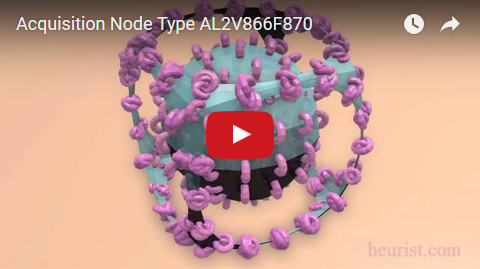
Typical Knowledge Acquisitions Node

Link to video...

Knowledge Representation

A typical knowledge acquisition node showing two layers of abstraction. Note how some of the acquisition field detection moves with the observer's perspective. You can tell, due to the varying visual aspects of the fields and their conjunctions that it has already been primed and in use.

This node may be one of thousands/millions/billions which form when acquiring the semantics of any particular signal set.

Their purpose is to encode a waveform of meaning.

Basically it is these 'guys' which do the work of 'digesting' the knowledge contained within any given signal; sort of like what enzymes do in our cells.

The size, colour (although not here represented), orientation, quantity, sequence, and other attributes of the constituent field representations all contribute to a unique representation of those semantics the given node has encountered along its travel through any particular set of signal. The knowledge representation (not seen here) is comprised of the results of what these nodes do.

This node represents a unique cumulative 'imprint' or signature derived from the group of knowledge molecules it has processed during its life time in the collation similar to what a checksum does in a more or less primitive fashion for numerical values in IT applications.

I have randomized/obfuscated a bit here (in a few different ways), as usual, so that I can protect my work and release it in a prescribed and measured way over time.

In April I will be entering the 7th year of working on this phase of my work. I didn't intentionally plan it this way, but the number 7 does seem to be a 'number of completion' for me as well.

The shape of the model was not intended in itself. It 'acquired' this shape during the course of its work. It could have just as well been of a different type (which I'm going to show here soon).

Important is the 'complementarity' of the two shapes as they are capable of encoding differing levels of abstraction. The inner model is more influenced by the observer than the outer one, for example. The outer shape contains a sort of 'summary' of what the inner shape has processed.

Monday, August 31, 2015

A Holon's Topology, Morphology, and Dynamics (2a)

Holons Topology, Morphology, and Dynamics (2a)

This is the second video of a large series and the very first video in a mini-series about holons. In this series I will be building the vocabulary of holons which in turn will be used in my knowledge representations.
The video following this one will go into greater detail describing what you see here and will be adding more to the vocabulary.

This is the second video of a large series and the very first video in a mini-series about holons. In this series I will be building the vocabulary of holons which in turn will be used in my knowledge representations.

#Knowledge #Wisdom #Understanding #Insight #Learning #MathesisUniversalis #ScientiaUniversalis #Holons   #BigData  

Thursday, August 6, 2015

Ontology: Compelling and 'Rich'

Ontology: Compelling and 'Rich'
They are only surfaces, but they seem to provide you with depth.

This exquisite video shows how the representation of knowledge is ripe for a revolution. I've written about this in depth in other places so I won't bore you with the details here unless you ask me in the comments below.

Stay tuned! I'm behind in my schedule (work load), but I'm getting very close just the same. I will publish here and elsewhere.
I'm going to use this video (and others like it) to explain why ontologies are not sufficient to represent knowledge.

Soon everyone will acknowledge this fact and claim they've been saying it all along! (In spite of the many thousands of papers and books obsessively claiming the opposite!!!) They do not know that how dangerous that claim is going to be. Our future will be equipped with the ability to determine if such claims are true or not. That's some of the reason I do what I do.

#KnowledgeRepresentation #BigData #Semantics #Metaphysics
#Knowledge #Wisdom #Understanding #Insight #Learning #MathesisUniversalis #MathesisGeneralis #PhilosophiaUniversalis #PhilosophiaGeneralis #ScientiaUniversalis #ScientiaGeneralis 

Tuesday, July 28, 2015

Knowledge Representation Foundations
It's also stuck in ontological framing, but the approach and results are fascinating.

Source:
http://seedmagazine.com/content/article/scientific_method_relationships_among_scientific_paradigms/

"This map was constructed by sorting roughly 800,000 published papers into 776 different scientific paradigms (shown as pale circular nodes) based on how often the papers were cited together by authors of other papers."

"Links (curved black lines) were made between the paradigms that shared papers, then treated as rubber bands, holding similar paradigms nearer one another when a physical simulation forced every paradigm to repel every other; thus the layout derives directly from the data."

"Larger paradigms have more papers; node proximity and darker links indicate how many papers are shared between two paradigms. Flowing labels list common words unique to each paradigm, large labels general areas of scientific inquiry."

Others doing work on this:
http://www.mapofscience.com/

Flickr (versions to download):
https://www.flickr.com/photos/7446536@N03/430561725/

Paper on Illuminated Diagrams:
http://www.textarc.org/appearances/InfoVis02/InfoVis02_IlluminatedDiagrams.pdf
(Also one in German that is VERY comprehensive!)
http://gerhard_dirmoser.public1.linz.at/Anwendungskontext_Diagrammatik.pdf

Enjoy!!!

h/t +John Verdon
Introduction.
Manuel DeLanda. 2015. Philosophical Chemistry: Genealogy of a Scientific Field. Bloomsbury
"There is no such thing as Science. The word ‘Science’ refers to a reified generality that together with others, like Nature and Culture, has been a constant source of false problems: are controversies in Science decided by Nature or Culture?"

"Avoiding badly posed problems requires that we replace Science with a population of individual scientific fields, each with it own concepts, statements, significant problems, taxonomic ad explanatory schemas. There are, of course, interactions between fields, and exchanges of cognitive content between them, but that does not mean that they can be fused into a totality in which everything is inextricably related. There is not even a discernible convergence towards a grand synthesis to give us hope that even if the population of fields is highly heterogeneous today, it will one day converge into a unified field. On the contrary, the historical record shows a population progressively differentiating into many subfields, by specialization or hybridization, yielding an overall divergent movement."

#Knowledge #Wisdom #Understanding #Learning #Insight #KnowledgeRepresentation

Friday, May 29, 2015

Precursors Of Knowledge

Precursors Of Knowledge
Fractal fields provide a nice framework in which to think about knowledge. They are not all we need for precision, but they are helpful in a generic way. I'll be posting more on them as the knowledge representations are published, because there are many 'gaps to fill' to show how these relate to knowledge.
A Unifying Topology of Fractal Fields

More sources:
https://www.youtube.com/watch?v=2nTLI89vdzg
https://www.youtube.com/watch?v=1ZVNIZGw4X0
https://www.youtube.com/watch?v=Yp4ogF2w13M
https://www.youtube.com/watch?v=8UPD2_gEjvM
https://www.youtube.com/watch?v=ArZLXHVVV5I

Tuesday, May 26, 2015

Coming Soon To A World Near You
The time is coming when we will exchange massive amounts of knowledge between us without any corporation standing in between.
My life's work is dedicated to this vision and I'm actually carrying it out right in front of you!

We will not only create and share our books, documents, web sites, search results, and media with each other - we will be sharing their conceptual landscapes.

3D Scientific Visualization with Blender
It's a book everyone in knowledge representation should at least know about. It has great tips and clarifications inside.

Unfortunately it is also based solely on ontologies so it provides only limited value for what I'm doing, but it is a valuable resource for understanding and creating visualizations just the same.

Video - Rendering a data cube:
https://www.youtube.com/watch?v=3GvTTVEeEmk
Video - Colliding galaxies:
https://www.youtube.com/watch?v=CPuVfiWLlHI


Tuesday, May 5, 2015

Lynda.com - Overview of Data Visualization
(Lynda.com - Overview of Data Visualization)

Information Visualization Is Not Knowledge Representation

This great video from Lynda.com shows how the processing language/interpreter is great for modeling information.
With such a multitude of interesting ways to model data, we find it hard to resist the temptation to call this knowledge, but it's not!

All of the wonderful representations here still require us to interpret their meaning!
What if there were a way to present knowledge in which our own understanding is not required to interpret them? What if our understanding of what we have presented to us becomes part of the presentation itself, and in fact, influences what we take from that representation?

We obviously need knowledge representation that can provide their meaning on their own for only they can provide a true understanding of their inherent structure and dynamics.
You see real understanding is the personalization of knowledge into your own mind. If your mind cannot dialog with that knowledge, it's not really yours and if your mind does all the work, it's only information.